Wednesday, 1 June 2016

London


For those of us who grew up with the BBC on radio and TV (transmitted via our ABC), read Enid Blyton books then graduated to Dickens and Austen, cheered on the brave chaps in grainy old war movies, saw the Royal Family featured in every women’s magazine and studied a British-centred History curriculum, visiting London is a little bit like coming home at last.  And I know that’s quite a ridiculous thing to say about one of the world’s great metropolises where you are just as likely to hear Urdu or Croatian spoken as English, and much more likely to see a sari or a hijab worn than a bowler hat, but London seems to carry traces of all its past incarnations. The memory of Roman roads lives on in the layout of major streets; the streets themselves are named for the old trades that were conducted there. There are remnants, ruins and scars of centuries: relics of the Great Fire; the blackened bricks from the Age of Steam, clusters of gravestones from countless plagues, bomb damage from the Blitz as well as all the official memories – plaques, statues, dedicated buildings, portraits, libraries and museums. Peter Ackroyd develops this theme in his wonderful Biography of London.  Places seem to hold a memory of their previous uses – a church is likely to have been the site of a temple, and perhaps a holy site long before that; an Adult Shop occupies the space where an Elizabethan brothel operated; auto repairs are carried out where coaches used to be made, which no doubt made chariots in earlier times. It would take a lifetime to explore this amazing city, and even that wouldn’t be enough, because it creates something new every day.


We decided on a ten day visit to London while Terry was recuperating from his heart surgery and not allowed to put any strain on his chest (lines, winches, outboards etc) – and it seemed like the perfect time. After all, Shakespeare warned us “summer’s lease hath all too short a date.” And perfect it was, mild weather, several days of outright sunshine and everything green and in bloom. Lines of poetry about bluebells, lilacs, ancient oaks and chestnut trees kept popping into my head at every turn. AirBnB came up trumps with a lovely Victorian house in Merton Park near Wimbledon, home of Bernadette and Tudor, their son and Fred the cocker spaniel. Both history graduates and enthusiasts, Bernadette and Tudor were able to advise us on interesting things to see and do, besides filling in the fascinating stories that surround almost every building, street corner and field.
Our B&B in Merton Park

Merton Park, for example, was the estate of Horatio, Lord Nelson, and though there is nothing left of the house he shared with his mistress Emma Hamilton, we were able to see their pew in the beautiful old Church of St Mary the Virgin, just down the road. William Wilberforce, the abolitionist, lived nearby, and William Morris had his model factory and design studio here. Emma Davison, the suffragette who died under the hooves of the King’s horse at Epsom, spent her last night at a house on the corner. And so on.
Terry managed to find four Geocaches while wombling around Wimbledon Common, and several others around Merton Park and London. The Geocache locator looked like a massive Christmas tree with thousands of lights, so a token effort was good enough for the moment. Hundreds of people were out on the Common, walking, riding bikes and horses and generally enjoying the perfect weather.

Inscription on Nelson's pew in Merton Church

A walk down a country lane - lilac, wisteria and forget-me-nots


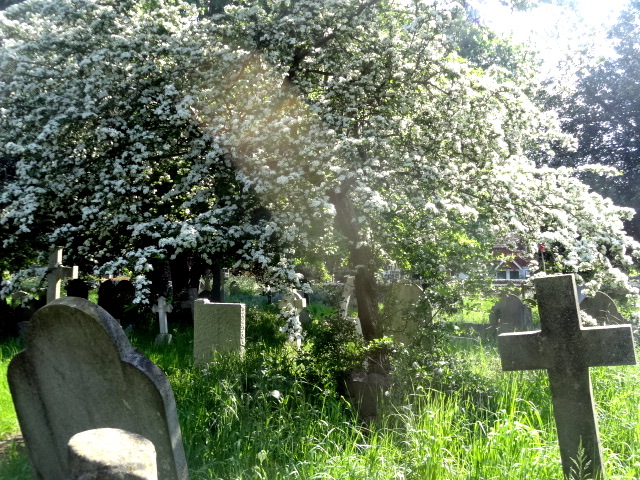
Churchyard, Merton church

We were about ten minutes by train from central London so we could do daily forays into the busy, teeming city then retreat back to a leafy haven of peace and quiet. Perfect! We managed to see most of the obligatory sights that seemed so familiar – the Tower, the Palace, the Abbey, all those Monopoly board streets – but I’ll just write about a few highlights here and bore everyone with all the rest when we get home.

One of our first outings was into the City proper for Terry to make a pilgrimage to the Bank of England. It really was very interesting – a walk through their museum is a journey through the history of Empire, the financing behind the great expeditions, the slave trade, the South Sea Bubble, centuries of wars, the trading dynasties. Walking around the streets you can’t miss Lord Nelson atop his column in Trafalgar Square (where I was spattered by a pigeon, just as I was in Times Square – the bastards missed me in St Mark’s). The Admiral was a bit of a theme on our visit. We saw his blood-spattered, bullet-holed jacket at Greenwich along with other memorabilia, the Great Hall where his body lay in state and his tomb at St Pauls. We actually sailed over the site of the Battle of Trafalgar on a very rough day after a failed attempt to reach Tangier in 2012, managing to spare a thought for the great man and for all those who lay below in the depths.
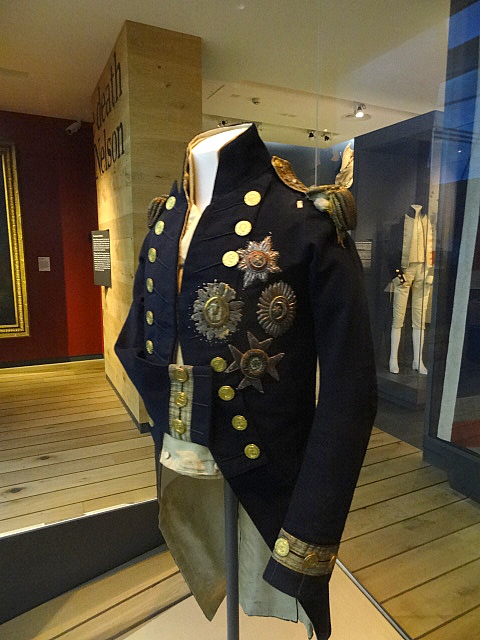
Nelson's jacket


Darwin presides over the Natural History Museum

London is an expensive city, but a lot of its museums, galleries and parks are free. We went to both Tate galleries, the National Gallery (to see Leonardo’s Virgin of the Rocks, to me the world’s most beautiful painting), the British Museum, the Natural History museum, the Victoria and Albert (loved the history walk-through and the costumes) and the National Portrait Gallery. I really like portrait galleries. There’s always a few good stories to go with the faces, often of people who have made a really significant contribution to humanity though you’ve never heard of them. (Previous discoveries include Douglas Waterhouse, the blessed inventor of Aerogard and supervisor of George Bornemisso’s dung beetle project who made it possible to go outside in Australia in summer, in the Australian National Portrait Gallery; Charles Drew the African-American inventor of the Blood Bank who later resigned from the Red Cross when it refused to desegregate blood (!) at the US National Portrait Gallery in Washington DC). London’s gallery was predictably full of royals, military men and a few literary types. The change in portrait style over four hundred years was fascinating in itself, but my favourite was Beatrix Potter, as your dear old aunty who’s gone a bit batty.
QE1
Beatrix Potter
We had hopes of getting to a few shows but being a Parky and a recovering heart patient took its toll of both of us. We ended up just getting to one, but “Sunny Afternoon”, based on the story of The Kinks, was wonderful – great music, high energy and according to Terry who actually saw The Kinks back in the day, the cast nailed it. A mind-boggling array of plays, musicals and exhibitions is on offer, and constantly changing. Next time we’ll be better prepared and ration our energy.
Food was expensive and not great, though I’m sure there are wonderful top end restaurants if you want to pay the price. On the other hand there were plenty of great pubs, many with endearing names, an honourable history and some good hearty beers and ciders, to be reviewed by the Captain in a later blog.
We did a lot of walking around, just taking it all in. And on one such walk, it just happened to be the Opening of Parliament and I was strolling down Whitehall when through the massing crowds I saw a carriage accompanied by Horse Guards. It was Charles and Camilla heading to Westminster. And, as I perched precariously on a sort of kerb, a golden carriage appeared bearing Her Majesty! So I really did get to see the Queen! She looks a little different from the first time I saw her in 1962, but for ninety, she’s doing very well.
Sorry, best I could do. Charles and Camilla are in there...
We ran out of time, of course, to do everything, and towards the end we had to split up to see the things we really wanted to see. So while Terry headed to St Pauls to pay homage to Nelson, I took a tour of Westminster Abbey (Do book ahead through their own website to skip the long queue.) This was a highlight for me, a place I’ve wanted to see for about 50 years. And it didn’t disappoint. The majestic old building, with its familiar spiky towers, parts of it dating back to before the Norman Conquest. Edward III (the Confessor) rebuilt it in the 11th Century and is the earliest of the monarchs buried there. It really is awe-inspiring to stand beside a stone sarcophagus holding the nearly one thousand year old bones of a king, and to reflect that this is where William the Conqueror was crowned. I love those stone sarcophagi with effigies of the deceased carved life-sized on the top. They are generally remarkable likenesses, and the small details – a woman piously reads a book, a knight’s faithful dog curls at his feet, a couple clasp hands - serve to humanise these long-dead aristocrats. (My favourite ever was a Roman tomb in Elmali, Turkey, where a stone couple are engaged in the familiar battle of the bed-covers. The husband has hogged the quilt, exposing his wife’s bedsocks for all eternity.) Elizabeth I is there in Westminster, and the two Marys, the bitter divisions of faith resolved in the grave. Chaucer is buried in this, his workplace, and he commands what has become Poets’ Corner, resting place of many great British writers including Charles Dickens, Samuel Johnson, Thomas Hardy and Lord Tennyson. Great scientists including Darwin, Wallace, Rutherford, Faraday, Lister, Florey and Newton are interred in the Abbey and many other greats have memorials. One of the most moving memorials is a beautiful stained glass window commemorating those who died in the Battle of Britain; it replaced a window destroyed in the Blitz. I could happily spend another day or ten exploring this wonderful Gothic treasure trove!


So, we barely scratched the surface of this great city, let alone the whole of the UK that is still beckoning. We will be back soon for sure.

Nelson surveys London from his column


Saturday, 23 April 2016

Valencia (Terry)


There's a lot to say about Valencia, one of the most liveable cities we've encountered in our 5 years of travelling.  Big enough to be exciting and small enough to be accessible to the citizens. I've included a link to a superb Valencia blog by a Valencia resident - 

http://nothemingwaysspain.blogspot.com.au/
It is well worth reading. 


It is a remarkable city for many reasons, few of which are about excitement and spectacle and most of which are about a city which promotes modern living with great recreation opportunities.


It is also a favourite of mine because it was once ruled by El Campeador, Rodrigo Díaz de Vivar (c. 1043 – 1099), also known as El Cid, or simply Rodrigo, one of my childhood heroes..


Marina

The Marina was built for the Americas’ Cup and is named for King Juan Carlos.  It is modern and well laid out, with a substantial breakwater which gives a great deal of protection.  We were tied up at the end of a pontoon with the Spanish training vessel Cervantes opposite us.  Being on the end gave us a view of the comings and goings on the waterway and as luck would have it we were only a short distance from the city's Youth Water Activities club (not sure of the translation)


Cervantes


Kids water club - The Optimists 

This looks like chaos but the kids are very skilled and rarely bump.  They race up and down the marina, as they do in numerous other European cities.  Often after a race down to the marina entrance they will tie one Optimist to another and sit in the first one to talk on the way back. (as I sit here in Cartagena on a Saturday morning in late April, the Optimists and dinghies are beginning to head out for a few hours racing)

                              
They do know what they are doing

The kayak races are conducted on the far side of the waterway and are full of spray and shouting.  At the end, all the kayaks tie bow to stern and they get a ride back upstream with the minder boat pulling them.  Easy way to finish the day.


Beach

To the east of the marina is a sandy beach which stretches for some miles.  While we were there, I was treated to a rare spectacle in the Med – surf!  Admittedly there was not a lot of power in it but nevertheless, it was rideable, shoulder-high, peeling, long and breaking over sand.  The swell lasted about 3 days, although it petered out completely on day three.  Lots of Valencians took advantage of it, and a huge number gathered on the breakwater to watch, as the walkway on the breakwater is well suited to walking and watching.


The beach itself attracts many locals and tourists, with a run of hotels immediately on the beachfront. The restaurant prices are a tad over the top for Spain so we avoided them completely.  Better value in the suburbs.  It is also the venue for some quite amazing sandcastle art.  The sand sculptors are similar to buskers, in that a stop and study and photo is meant to generate a donation. 


Cathedral


The view from the belltower.  The green belt of the parkways is in the middle of the city in the distance.


Water Court


The water court has been sitting in Valencia for a thousand years and was probably a Moorish institution.  It is the oldest continually sitting democratic institution in Europe.   Proceedings are conducted in Valencian and decisions are final.


Parkways

This was to me one of Valencia’s main attractions.  Formed from the old river course, it is an extensive run of cycleways, running tracks, walkways, exercise stations and relaxation areas.  One would guess that the opportunity afforded by many kilometres of inner-city land would have been given over to developers and big money anywhere else in the world but Valencia chose to make the city more amenable instead.  Francoist bureaucrats wanted to make the riverbed a motorway but local opposition stopped them.


City of Arts and Science

If Valencia has a spectacle, this is surely it.  The buildings are remarkable.  We visited the aquarium and also the Omni theatre.


I think he should have waited until the guy finished inflating it!


Aquarium


The city markets

The markets are in a spectacular building but in themselves are not particularly exciting.  Cartagena's are bigger, and Palermo's are much more extensive.  I think it is because Valencia does not depend on one location only and the choices are more widely spread.  There is only one place to eat, standing, alongside a bar and it is extremely crowded with city workers having lunch.  Once a bar stool is taken, it's out of circulation for about an hour as Valencians use all their available relaxation time to socialise and enjoy their lunchtime beer and wine.


The Booze Bit


You probably can't see this without a) a magnifying glass or b) an explanation.
This is a stack of beer cartons in Carrefours.  It is made in Germany for Carrefours.  It is 0.17c a can..  That's about AUD 0.23c a can.  Seriously, $0.23c a can.


Bad Idea!  You think you are getting a double treat, Tequila and Beer in one bottle, so you buy a bucket.  Not good.  What you get is sugar and beer.  Bad.  Undrinkable.  Well, almost undrinkable.  I forced it down but I must say I wasn't pleased.


The end of a hard day's touring in Valencia, one of Spain's most enjoyable cities.

Sunday, 10 April 2016

Burriana (Terry)


Along the coast of Spain are several marinas that were built to capitalize on the Valencia America’s Cup.  Timing, they say, is everything, and these were built just before “El Crise” and there is now substantial free space in them.  As a consequence, prices are way down on, say, the coast of Italy or the south coast of France.  Good for some.  Us, for sure.

We called in to one of these called Burriana in order to get our electronics checked and fixed after our lightning whack.  September is not high season but even so, €20 a night is cheap anywhere, in a very nicely laid out marina with good secure facilities.  The only problem is that Burriana the big town is about 3km from Burriana beachside.

Our electronics were in the capable hands of Eddie Mauricio Achoy Hernandez.  Ah yes you say, you detect the Achoy in there.   Indeed, Eddie is widely known as Achoy.  A Guatemalan by birth, of Chinese descent, living in Spain for many years, Eddie is happy-go-lucky, curious and very pleasant company.  Of course, chasing down electrical faults is a bit of a no-win career.  You don’t find it until you find it and it seems to take forever to isolate the issue.  As it turned out, it took several days to fix the VHF and the GPS/Chartplotter but the eventual cost was offset by the fact that we had Eddie’s company for several days.
Eddie Mauricio Achoy Hernandez


Eddie's LightSabre - lights up like a LightSabre, sounds exactly like a LightSabre and looks exactly like a LightSabre.  From the genuine LucasArts factory, too.

The waterfront of Burriana boasts a magnificent Escola devoted to sailing instruction.  Students come from all over Europe (EU, as it is partly EU funded) to attend the college and learn high-end racing stuff.  

Around the corner from that is a superb bar.  To cater for the possibility that they might run short of beer at any time, the management has wisely installed two massive beer tuns.

These, in turn, feed into a beer delivery pipe of industrial proportions, keeping drinkers’ minds off the possibility that there could ever be a shortage of supply.


To cap it all off, they wisely set the daily control in the capable hands of two delightful young ladies from Eastern Europe.  When they discovered my interest in a Spanish telecast of an NFL game on TV in the main bar, they set Carol and I up on the restaurant bar with our own large TV to watch the game. The two Spanish commentators were quite knowledgeable and ran a great side discussion throughout.

Thank goodness for foresighted management I say

We did go into Burriana-the-town on two days.  It’s a fair hike but on day one, we asked a lady exiting a parking spot on the beachfront where the bus stop was.  She insisted we get in and she then drove us into town, depositing us outside the shops in the main street.


If you go to Burriana on Google Earth, you can see how underutilised the marina is.

While in town, we wandered around the famous church but found it locked up.  As I was checking the opening hours, and my watch, one of the retired guys who sit around town squares and set the world to rights came over and said he’d open the church for us.  He was one of the lay assistants there.  He insisted we follow him and took us around to the priest’s office and asked the priest to open up for us, which he duly did.  We had a private tour and were most impressed.


Burriana also boasts The Orange Museum, celebrating the area's links to the citrus industry.  However, we couldn't find it and the population of Burriana was evenly divided between "it's over in that street" and "it closed down 2 years ago".  We still don't know who is right and we didn't find it.


A hard day's fishing, Burriana-style


One irritation we did come across was that when we tried to go back to the boat on the second day, we waited at the bus stop for ages until a lady who worked at the supermarket alongsdide told us that the next bus was not for 3 hours!  She helped us ring a taxi but we then found out that ALL the taxis were on siesta and would not be back for another 2 hours!!  We had never come across this before but it left us with no choice but to hoof it 3kms back to the marina.  With a stop in the bar.

There were several UK cruisers in the marina planning to winter over.  Made good sense for them as they already had cars with them and getting back to England on the RyanAir-type flights was cheap and easy.  Marina fees were very low and the marina is very sheltered.

A pleasant stop on our way down the Spanish coast.


Thursday, 3 March 2016

Barcelona and Beyond

Gaudi's Sagrada Familia - almost finished!

Private house by Gaudi

Next stop for Common Sense was one of several marinas along the coast near Barcelona - Premia Marina - close to the home of our friends Laura and Olivier. Again we had the delight of meeting up with cruising friends when Laura appeared on the dock with baby Mae - and a basket of Spanish treats to welcome us: three kinds of jamon, tomatoes, fresh bread and local sherry. Yum! Mae seemed to know her way around a boat and instinctively took the wheel while Terry (thoroughly smitten) explained the instruments to her.

We spent the next day in Barcelona itself, taking the obligatory Big Red Bus orientation tour and checking out the wonderful architecture, and taking a stroll up Las Ramblas to find Olivier's restaurant - another happy reunion, though he was a lot thinner and paler than he was as skipper of Hephaistos! Las Ramblas is the place to be in Barcelona with its varied restaurants and cafes, markets, innovative shops and thousands of people from everywhere in the world.

Las Ramblas
We had a day at the local beach where baby Mae courageously took her first ocean swim despite the choppy conditions - she is clearly destined for a life at sea. Next day the wonderful hospitality continued, with Laura driving us up to the Catalan national park of Montserrat, with its Benedictine monastery nestled in beneath the saw-toothed mountain peaks. It has a funicular railway up to the top for spectacular views, and the abandoned cells of the more reclusive monks are still visible in the mountainsides. The monastery itself is austerely beautiful and there is even a nice little gallery, complete with Caravaggio for my collection!


Montserrat

The last day with our friends was spent shopping and visiting a local brewery to sample its wares, then a sad goodbye to Olivier, Laura and Mae. Thanks for a wonderful time and we hope to see you again at home, at sea or perhaps even as our guests in Western Australia where we promise you won't get bitten by a shark, snake or spider!